Research Rabbit Holes can be fabulously inspirational, or horribly time wasting. They can take you in directions that are wildly irrelevant to your story, or can help you add layers of authenticity and meaning to your work. In this series of blog posts I’m sharing some of my favourite journeys down these Research Rabbit Holes, and I’ve also asked some other writers about their experiences falling into these diabolical black holes of eternal fascination.
 This week’s guest is Ian McHugh, who sports what is surely one of the most resplendent beards in the Australian speculative fiction scene. His writing speaks for itself and has featured in publications such as Asimov’s, Clockwork Phoenix and Beneath Ceaseless Skies. He is renowned as a blunt and fearless (and therefore extremely useful) beta reader, and his critiques often start with a variation of: “Your story starts here on page 3.” He can frequently be found running workshops at the ACT Writers Centre, or teaching at the University of Canberra.
Tell me a little bit about your latest book/story and what sort of research you needed to do to write this story.
I’m currently writing a secondary world fantasy novel with early modern technology – steam engines and gunpowder weapons and whatnot – combined with magic. It’s not steampunk, I just wanted to step away from the standard medieval-era for adventure fantasy. So, I needed to know early steam technology, firearms and artillery, as well as naval warfare in the transition from sail to steam, siege warfare with early cannons and (because it’s a magical secondary world) golems.
What was the most interesting or surprising thing your research turned up?
This current project started with canals. The canal infrastructure from the early industrial revolution in Britain was incredible. They had actual mechanical lifts – not locks, lifts – for barges, where the barge would go into a gated tub and be lifted, water and all, straight up a cliff, with a counterweight tub coming down. So, that canal infrastructure became a bigger part of the story as I wrote, and a number of the pivotal moments in the story are built around canal things.
How does research fit into your writing process? Do you research first, then write, or do you research as you write?
I tend to research big things before I start writing, then research details as I go. As such, research is important to both my writing process and my procrastination process. It also means I do a fair bit of backtracking to retrofit corrected details as I write, so forward progress some days can be slow even if I’m working hardly rather than hardly working.
Is research a distraction or an inspiration?
I think once you have writer-brain, everything and anything can become research and inspiration. Generally speaking, research is inspiration. Research is also incredibly distracting. So many rabbit holes to disappear down! For example: I recently wanted to know if a 1700s era cannon was in an elevated position – on top of a wall, say – how close to the foot of the wall could it shoot? How did they shoot downwards? Could a cannon’s barrel be declined to shoot downwards? Was it ever the done thing? I lost hours. Found a multiplicity of blogs and rants and treatises and articles and instructional manuals about the optimum angle of elevation for maximum effective range for every kind of cannon and carronade and culverin and mortar and firestick. But what about when the other fellas are nearly at the bottom of the wall? I know they used a cotton bung to stop the cannonball rolling out when the gun was pointed down, but beyond that, I’m as ignorant as when I started.
When you’re writing secondary-world or alternate-world stories, how does real-world research contribute to your world-building?
Something like how to shoot artillery from the top of a wall might seem like a detail I could write around, but it’s the little details that can catch you. If I want to have my characters defend a fortress when both sides have artillery, I need to know what the actual real strategies were for both attacking and defending a fortress with artillery. Just because it’s a secondary world, I can’t just make shit up that sounds good to me, because it will probably be completely wrong. Whatever secondary world you’re writing, it’s going to have a lot of real-world stuff in it. You have to get that stuff right first, if you want your secondary world to have any kind of credibility, then figure out how your magic and dragons and whatevs fit in with it and change it.
Tell me about a time when your research threw up something that changed your story or a character.
I think you need to approach research with the expectation that it’s going to change your story, because research is a critical part of the process of developing and refining your story idea. And, if you’re like me and keep researching as you write, it’s also part of your drafting process. As such, every bit of research tends to have consequential changes for my plots and scenes and worlds. Less so with characters, I think, unless they’re non-human (and I find a cool way to pimp them up some more) or based on historical figures (and I turn up an interesting factoid about the real person).
I have a draft of a historical fantasy novel currently filed in the Cry For Help folder, which featured a version of Peter Lalor, the leader of the Eureka Stockade gold miners’ rebellion. I originally conceived him as a fairly idealistic figure, but then reading about the real man, I discovered that, after leading this rebellion to demand democratic rights for gold miners, he became a member of parliament and voted against those rights. Although the men he led to take up arms were Chartists and other advocates of democracy, Lalor wasn’t. He was a republican and a liberal, but not a democrat. Given that the conceit of my novel is, in part, “what if Lalor’s rebellion was successful?”, this tidbit threw up some interesting questions. So my version of Lalor now became a kind of Australian Robespierre and his rebellion/revolution followed the template of the French Revolution – including the Terror. Suddenly my character had way more depth and a way more interesting arc.
Have you ever researched something that made you abandon a story idea?
I said before that research is inspiration. Sometimes it’s also an obstacle or a roadblock. I don’t know that I’ve ever abandoned a story because of something my research turned up, but research often turns up inconvenient bits of knowledge that then need to be accounted for. In my story (deep breath) Extracted journal notes for an ethnography of bnebene nomad culture, I conceived an alien species with five genders. Initially, I just said they had three available sex chromosomes which could be paired in five viable combinations. But then I read about the other non-chromosomal ways that gender is determined in nature, like temperature variance and haplodiploidy (look it up), so I had to not only have my scientist protagonist consider those possibilities as well, but I had to consider for myself whether they were more realistic than what I’d proposed.
What was the weirdest thing you had to research?
Research for stories is often esoteric, but I think it’s only weird to other people. If you’re geeking out on it, it never seems weird. And if you’re (if I’m) researching for a story, then you’re (I’m) probably geeking out. You just end up knowing a lot of unusual factoids – for my recent story Demons Enough I decided I needed to know how much blood is in an adult human (five litres, for anyone who’s interested). Knowing it wasn’t critical for the story (read it, you’ll see) and finding it out didn’t change how I told the story, but I was geeking out on the story, so I wanted to know. Not weird at all, see?
What kind of research have you needed to do for stuff that doesn’t exist? How do you approach that?
If you’re writing speculative fiction of any kind you’re always researching for stuff that doesn’t exist. I think most of the time, you’re riffing on what’s real – extrapolating technology or politics, mashing things together to make a monster, filing off the serial numbers from some meditative technique and saying that’s what you do to work magic. And if you’re not riffing on what’s real, you’re probably riffing on something someone else made up before. So, for me, I don’t think there’s a difference in the research approach – writer-brain is always switched on. It’s more what I do with it once I’ve done the research. If I’m researching something that exists, then I regurgitate it as accurately as possible into my story. If I’m researching something that doesn’t exist, then I bang together things that do until I get sparks of something new.
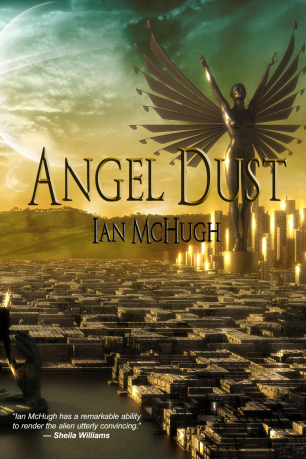 Ian McHugh’s first success as a speculative fiction writer was winning the short story contest at the 2004 Australian national SF convention. Since then he has sold stories to professional and semi-pro magazines, webzines and anthologies in Australia and internationally. His stories have won grand prize in the Writers of the Future contest, been shortlisted five times at Australia’s Aurealis Awards (winning Best Fantasy Short Story in 2010), reprinted in Australian year’s best anthologies, honourably mentioned for world year’s bests and appeared in the Locus and Tangent Online annual Recommended Reading Lists. He graduated from the Clarion West writers’ workshop in 2006. His first collection of short stories, Angel Dust, was shortlisted for the Aurealis Award for Best Collection in 2015.
Ian lives in Canberra, Australia and is a member of the Canberra Speculative Fiction Guild.





 Leife Shallcross