Beilby’s Ball

For anyone writing about or interested in Britain in the 18th and early 19th century, the 1811 Dictionary of the Vulgar Tongue: a dictionary of buckish slang, university wit and pickpocket eloquence, brought to you by Project Gutenberg, is an indispensable resource.

Here’s a little gem I came across today:

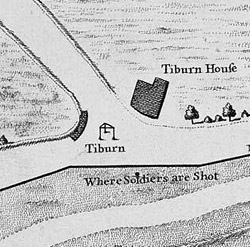
BEILBY’S BALL. He will dance at Beilby’s ball, where the sheriff pays the music; he will be hanged. Who Mr. Beilby was, or why that ceremony was so called, remains with the quadrature of the circle, the discovery of the philosopher’s stone, and divers other desiderata yet undiscovered.

Tyburn_gallows_1746

Map of Tyburn gallows and immediate surroundings, from John Rocque’s map of London, Westminster and Southwark (1746), courtesy of Wikipedia.


Achievement unlocked!

2016_HARDCOPY+tag_Colour

I had some exciting news this week: I’ve been accepted into the ACT Writers Centre 2016 HARDCOPY professional development program for Australian writers! This is the third year they’ve run the program, and the second year they’ve focussed on fiction authors (2015 was a non-fiction year). Applying for HARDCOPY involves a competitive selection process, which included submitting a synopsis and the first 30-50 pages of the manuscript, so being offered a place is definitely an achievement in itself.

Even better, my good friend and writing buddy Robert Porteous has also been accepted into the program, so I know I’ll be in very fine company.

On wordcounts

The Wordcount is a capricious beast. It is simultaneously the carrot and the stick. The milestone by which you mark what you’ve achieved, and the one that tells you just how far you have to go.

My current novel WIP is sitting on about 65,000 words. I envision it will come in around 90-100,000 words. Which means I’m about 2/3 of the way there. But, hoboy, those last 5000 words have been a slog. I don’t quite know why. I’ve got the key plot stuff all planned out, but I’m having trouble moving between plot points. Generally this means I’ve got to go back and do a bit more work on shoring up the foundations of my story, but that’s a whole other blog post.

A piece of tried and true writing advice is that if you commit to writing a certain amount of words a day (or a week, whatever), it will only be a matter of time before you’ve completed your 80,000/90,000/120,000 word novel. And that’s true…to an extent. It’s not quite the whole picture, though. You can write 90,000 words in three months, but if by then your protagonist hasn’t yet found the magic widget, vanquished the evil nemesis and saved the cat, you’re not finished. You might have another 10,000 words to go. Or another 50,000.

If you’re a good planner – or, perhaps I should say, if your writing practice revolves around planning your work – wordcounts are probably a really good yardstick by which to measure how you’re meeting your writing goals. You probably know you want to write a 90,000 word story and you know X will happen by 30K, Y by 45K, and Z will happen in the last 5K. Great.

But I’m more of a pantser. I feel like this will be a 90,000 word story. I’ve got my plot bones set out, but I don’t do detailed planning around how I’ll get from A to B to C. I’ve already had to revise my chapter plan about 4 times, because the stuff I thought would happen in chapter 7 won’t happen now until chapter 10. It’s all good. That’s what first drafts are for – working all this stuff out. The thing is, though, I find I just can’t commit to progressing my story to a certain point within a certain wordcount. So, for me, I often find that plot milestones are a better way of measuring the development of my work. Have we found the magic widget? OK, now we’re halfway through. Have we just set out to vanquish the nemesis? OK, that’s the 3/4 mark.

BUT.

The wordcount is still there, sitting down in the bottom corner of Word, alternating between mocking me and being a triumphant marker of progress. I’ve found myself falling into the trap of thinking “I’m in that mid-draft slump. When I’ve reached 70,000 words, I know I’ll be doing OK.”

The fact is, though, I am doing OK. I’ve written 65,000 words. They’re not perfect, but I’m generally happy with them. And having the manuscript sitting at 70,000 words won’t be any guarantee that the 2000 words between 70 and 72 K won’t also be a bloody hard slog. There are times when it feels like I am inching myself forwards by the raw edges of my chewed-off fingernails. But I’m not in bad company.

George R R Martin on writing A Dance With Dragons:

The last one was a bitch. This one was three bitches and a bastard.

I just have to keep on swimming.

Finding-Dory-poster-xlarge


Adventures in the South

I’ve just come back from a week’s holiday in Hobart, Tasmania. I’d never been before, despite having a mother who is a confessed Tasmanophile and plenty of friends who have been telling me for years how much I’d love it. And I have to agree: Tasmania is a beautiful place and Hobart is a beautiful city. We based ourselves there for a week and did a few day trips, as well as taking a bit of time to soak up the city itself. Here are a few things that really stood out.

ningina tunapri

I’m going to mention this first, because while there are many wonderful things about Tasmania, I think it’s important to acknowledge the darkness and heartbreak in its colonial past. ningina tunapri is one of the permanent exhibitions in the Tasmanian Museum and Art Gallery that “explores the journey of Tasmanian Aboriginal people and is a celebration of all Tasmanian Aboriginal generations.” There are some genuinely inspiring and beautiful parts of this exhibition – the baskets woven from water iris were especially lovely. But I left in tears after reading through some of the atrocities early British colonists perpetrated on the Indigenous Tasmanian people, and of the heroism of those people. Importantly, this exhibition presents these stories in the words of the Aboriginal people themselves. I have so many thoughts on why this is important, which I might save for another time. But what has really stayed with me is how the grief and anger over those terrible events is something that is still here and will always be there. It can’t be fixed, but it must be respected. (In my mind respecting that hurt involves things like acknowledgement, empathy and demonstrating commitment to eradicating racial discrimination.)

Mount Wellington
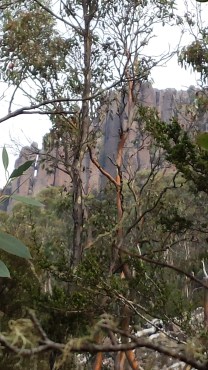
2016-04-15 11.47.07Mount Wellington looms over the city of Hobart at 1000 metres above sea level. It is huge. We drove up it on the evening of our first day in Hobart, and again on the morning of our last day. It is one of the most awe-inspiring natural monuments I’ve ever encountered, and looking up at those crazy rocks above me, I can understand why things like that get worshipped as gods.

Driving up it at dusk, in the mist, we felt as though we were about to drive off the edge of the world. The road is narrow and winding, and the drop at the edges was terrifyingly sheer. Mt Wellington’s most impressive feature is this giant wall of vertical rock columns called the Organ Pipes, which are the result of cooled-down magma from ancient volcanic activity. They are enormous and simply astoundingly picturesque. Especially when you suddenly find them looming over you half way up the mountain.

20160410_174711The crazy rocks and sheer elevation of the summit makes it one of the eeriest places on Earth. The first evening when we went up, the wind was so strong, we could barely breathe, let alone stand still. It was almost impossible to hold the camera still enough to take photos. And, holy hell, it was cold. Our car said it was 5 degrees out. Apparently Mt Wellington often gets snow in summer.

We went back on our last day in Hobart and did a bushwalk along underneath the Organ Pipes, which was pretty challenging. A lot of the path crosses old rock falls, and it’s pretty rough. But, bleak as the landscape is, it is very lovely. And the air is crystal clear.

2016-04-15 11.28.40.jpg

The Huon River

This is a part of Tasmania I’d like to explore a bit more. The trees were huge, and the water in the river is this amazing mahogany colour from all the tannin in the leaves of the forest that fall into it.

2016-04-13 14.39.42

Hobart wharf

The harbourside at Hobart is a great place to wander around – during the day and at night – with all the old Georgian architecture and the fishing boats piled with lobster pots.

Sadly we concluded it was not lobster season, because we couldn’t find any places serving lobster.

Daci & Daci Bakery

There’s probably not much more I can say about this temple of deliciousness, other than to note we went there three times in the space of the six days we spent in that city.

It is absolutely the quintessential shop of treats, with its polished wood counter and tables, its gleaming glass displays filled with all manner of cakes and pastries, its gloriously mismatched tableware and the sheer array of sugar dusted, cream filled, fruit garnished, toffee glazed, chocolate coated delicacies. We can definitely recommend the chocolate eclairs, the creme brulee and the violet meringue.

The gin
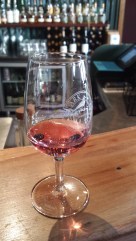
2016-04-10 14.28.53

Tasmania is, apparently, known for producing quality booze. My partner spent a fair bit of time sampling the various whiskys the island has to offer. I’m not a whisky aficionado, but I am partial to a gin and tonic, and I’d heard good things about Tassie gins. On the left here is a gin and tonic made with Forty Spotted gin by Lark Distilleries. It is one of two I had the pleasure of sampling that are flavoured with native Tasmanian botanicals. The bartender at Lark made this G’n’T with a couple of Tasmanian native pepper berries and a curl of ruby grapefruit rind to bring out those flavours in the gin. It was delicious.

The talent

On our last night in Hobart, I caught up with fellow writer Chris Large for a drink at a cosy bar in Salamanca. We spent an hour or so yakking about writing and stuff over a glass of really excellent Tasmanian Merlot. I usually only see Chris when he comes up to Canberra for Conflux in October, so it was nice to be able to meet up on his home ground for a change.

The verdict?

I’m really keen to go back. Next time, maybe we’ll do a BnB hop around the island, instead of basing ourselves in one corner. Or possibly even one of those 3-4 day hikes through the wilderness (my other half only does glamping). There’s so much more to explore.

 

Awesome words: Amaranthine

Amaranthine: Unfading, everlasting, particularly in relation to a flower. From the Greek amarantos, undying, and anthos, flower.

Amaranth is the name given to a genus of summer flowering plants, most of which go by the (very) common name of pigweed. Now, there’s a step down for you.

It’s also the name of a purplish-red colour and a synthetic red food colouring ( E123), used in packet soups, cakemixes, etc.

Why do I love it? Well, I’m a sucker for a word with overtones of colour and I think I conflate the purplishness of this word with amethyst, which gives amaranthine a jewel-like quality in my mind. I also like the association this word has with the concept of a magical, undying flower.

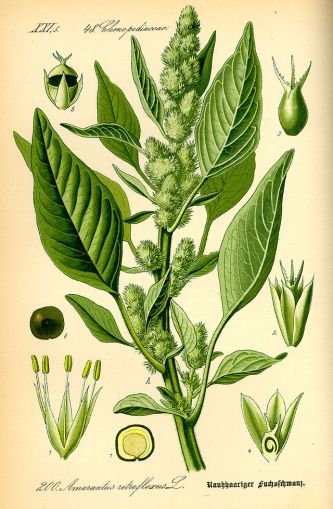
Illustration_Amaranthus
Red-root Amaranth (A. retroflexus) – from Thomé, Flora von Deutschland, Österreich und der Schweiz 1885

New blog theme

Spent a couple of hours fiddling around today with the blog theme. It did involve trawling through a few other writers’ blogs to see how they roll; so naturally I got sidetracked on reading a bunch of interesting posts on the art and craft of writing. So it kinda counts as research time.

What do you think?

How little girls deal with monsters

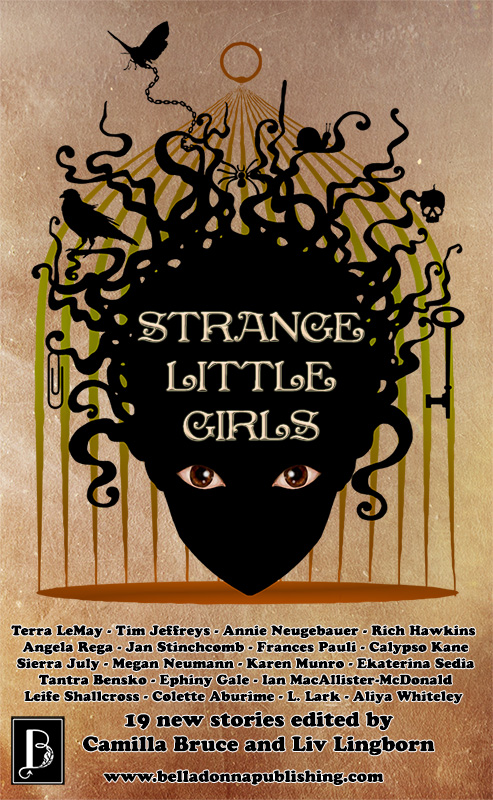
In celebration of the release of Strange Little Girls from Belladonna Publishing, I’ve put together a board on Pinterest with images I found useful in creating my story, “Pretty Jennie Greenteeth”. I have these boards for quite a few of my works-in-progress, but I usually keep them secret. This is the first one I’ve released. Click on the link below to head over to Pinterest to have a look.

Follow Leife’s board Pretty Jennie Greenteeth on Pinterest.

Pieris rapae
Pieris rapae (Johann Fournier)


All the Strange Little Girls

SLG-promo-cover2

I’m late, I’m late, for a very important date!

Hooray! As of 4 days ago Strange Little Girls is a real, live book you can hold in your hands (or on your kindle) and read and marvel over! For a little taste of exactly what is inside this treasure box of an anthology, head over to Belladonna Publishing for a delicious teaser of each of the stories.

I’m so in love with the cover art of this book, and the interior art is just as sumptuous. If you pick up a copy, I’d love to know what you think!

This.

Ira Glass on Storytelling from David Shiyang Liu on Vimeo.

It’s not just a useful reminder about what that spark is that tells us creatives we have something to offer the world, it also explains why we’re always trying harder, why we persist even when we haven’t quite measured up and…

…why, even when we haven’t necessarily hit the dizzying heights of perfection that are the standards we set for ourselves, we still have something to offer our friends, peers and colleagues in our field of creative endeavour that will help them improve as well.