I’ve just come back from a week’s holiday in Hobart, Tasmania. I’d never been before, despite having a mother who is a confessed Tasmanophile and plenty of friends who have been telling me for years how much I’d love it. And I have to agree: Tasmania is a beautiful place and Hobart is a beautiful city. We based ourselves there for a week and did a few day trips, as well as taking a bit of time to soak up the city itself. Here are a few things that really stood out.
ningina tunapri
I’m going to mention this first, because while there are many wonderful things about Tasmania, I think it’s important to acknowledge the darkness and heartbreak in its colonial past. ningina tunapri is one of the permanent exhibitions in the Tasmanian Museum and Art Gallery that “explores the journey of Tasmanian Aboriginal people and is a celebration of all Tasmanian Aboriginal generations.” There are some genuinely inspiring and beautiful parts of this exhibition – the baskets woven from water iris were especially lovely. But I left in tears after reading through some of the atrocities early British colonists perpetrated on the Indigenous Tasmanian people, and of the heroism of those people. Importantly, this exhibition presents these stories in the words of the Aboriginal people themselves. I have so many thoughts on why this is important, which I might save for another time. But what has really stayed with me is how the grief and anger over those terrible events is something that is still here and will always be there. It can’t be fixed, but it must be respected. (In my mind respecting that hurt involves things like acknowledgement, empathy and demonstrating commitment to eradicating racial discrimination.)
Mount Wellington
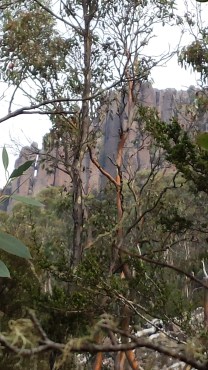 Mount Wellington looms over the city of Hobart at 1000 metres above sea level. It is huge. We drove up it on the evening of our first day in Hobart, and again on the morning of our last day. It is one of the most awe-inspiring natural monuments I’ve ever encountered, and looking up at those crazy rocks above me, I can understand why things like that get worshipped as gods.
Driving up it at dusk, in the mist, we felt as though we were about to drive off the edge of the world. The road is narrow and winding, and the drop at the edges was terrifyingly sheer. Mt Wellington’s most impressive feature is this giant wall of vertical rock columns called the Organ Pipes, which are the result of cooled-down magma from ancient volcanic activity. They are enormous and simply astoundingly picturesque. Especially when you suddenly find them looming over you half way up the mountain.
 The crazy rocks and sheer elevation of the summit makes it one of the eeriest places on Earth. The first evening when we went up, the wind was so strong, we could barely breathe, let alone stand still. It was almost impossible to hold the camera still enough to take photos. And, holy hell, it was cold. Our car said it was 5 degrees out. Apparently Mt Wellington often gets snow in summer.
We went back on our last day in Hobart and did a bushwalk along underneath the Organ Pipes, which was pretty challenging. A lot of the path crosses old rock falls, and it’s pretty rough. But, bleak as the landscape is, it is very lovely. And the air is crystal clear.

The Huon River
This is a part of Tasmania I’d like to explore a bit more. The trees were huge, and the water in the river is this amazing mahogany colour from all the tannin in the leaves of the forest that fall into it.

Hobart wharf
The harbourside at Hobart is a great place to wander around – during the day and at night – with all the old Georgian architecture and the fishing boats piled with lobster pots.
Sadly we concluded it was not lobster season, because we couldn’t find any places serving lobster.
Daci & Daci Bakery
There’s probably not much more I can say about this temple of deliciousness, other than to note we went there three times in the space of the six days we spent in that city.
It is absolutely the quintessential shop of treats, with its polished wood counter and tables, its gleaming glass displays filled with all manner of cakes and pastries, its gloriously mismatched tableware and the sheer array of sugar dusted, cream filled, fruit garnished, toffee glazed, chocolate coated delicacies. We can definitely recommend the chocolate eclairs, the creme brulee and the violet meringue.
The gin
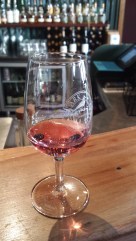
Tasmania is, apparently, known for producing quality booze. My partner spent a fair bit of time sampling the various whiskys the island has to offer. I’m not a whisky aficionado, but I am partial to a gin and tonic, and I’d heard good things about Tassie gins. On the left here is a gin and tonic made with Forty Spotted gin by Lark Distilleries. It is one of two I had the pleasure of sampling that are flavoured with native Tasmanian botanicals. The bartender at Lark made this G’n’T with a couple of Tasmanian native pepper berries and a curl of ruby grapefruit rind to bring out those flavours in the gin. It was delicious.
The talent
On our last night in Hobart, I caught up with fellow writer Chris Large for a drink at a cosy bar in Salamanca. We spent an hour or so yakking about writing and stuff over a glass of really excellent Tasmanian Merlot. I usually only see Chris when he comes up to Canberra for Conflux in October, so it was nice to be able to meet up on his home ground for a change.
The verdict?
I’m really keen to go back. Next time, maybe we’ll do a BnB hop around the island, instead of basing ourselves in one corner. Or possibly even one of those 3-4 day hikes through the wilderness (my other half only does glamping). There’s so much more to explore.









 Leife Shallcross