Here I am over at Angela Rega’s blog answering her searching questions about fairy tales…
This week’s Fairy Tale Friday is writer, Leife Shallcross. Leife lives in Canberra, Australia, with her family and a small, scruffy creature that snores. She reads fairy tales to her children at night, and then lies awake listening to trolls (or maybe possums) galloping over her tin roof. Her work has appeared in…[see more]
Conflux 11 is almost upon us! I’m especially excited about it this year, as I’ve been part of the organising committee and had particular responsibility for pulling the program together. There are still a few bits and bobs to sort out, but we are almost there.
Unfortunately I’ll be travelling for work on the Friday and Saturday, so despite it having completely taken over my spare time in the last few weeks I’ll miss those days. But I will be at the banquet on Saturday night, and there all day Sunday and Monday. Here are the panels you’ll be able to find me on:
2.30pm Sunday – I felt that – vivid prose, with Shauna O’Meara, DL Richardson and Alan Baxter.
4.30pm Sunday – Messing with mythology, with Amanda Pillar, Rob Porteous, Jane Virgo and Alis Franklin
10am Monday – Food in fiction, with Alis Franklin, Gillian Polack and Garry Dalrymple
4.30pm Monday – Fairy tales: princess complex, with Val Toh and KT Taylor
Plus…!
On Sunday at 5.30pm, the CSFG will be launching their latest anthology, The Never Never Land, containing my latest story “Adventure Socks”! Hope to see you there!
Image by Simon Howden, courtesy of FreeDigitalPhotos.net
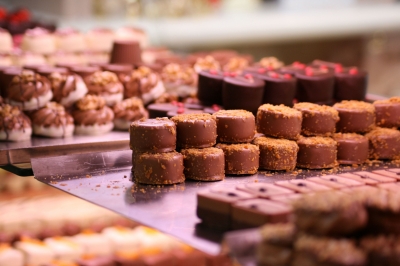
I’ve been indulging in some candy bar scenes this week. These are typically the scenes you hold off writing, because they’re the fun ones; the ones that signify major plot points or key emotional stepping-stones for your characters. You’re supposed to hang them out in front of you like a reward you get after the rest of the wordage is down.
I find, though, these are also the scenes that help me keep a story on track. They’re the ones that set the character of the whole novel, and the touchstones I keep returning to when I feel like I’m losing my way. Getting a candy bar scene down ahead of time can help me focus on where the bit I’m actually up to in the plot is heading. They’re also the points at which my characters shine brightest – where their personalities and motivations are most clear. So they also keep me focused on how I am developing the people inhabiting my story.
Typically, these are the scenes where my Muse kicks into overdrive, so they are addictive. I tend to find they leave me a bit wrung out, though. And often when I come to incorporating them into the story as a whole (imagine a kind of literary connect-the-dots), I find they are heavy on emotion, but lacking in the kind of world-building depth that really brings a story to life. That’s fine, though. That’s what first drafts are for, after all.
For me, the key issue is balance. If I write all my candy bar scenes all at once, I just end up with a bunch of disjointed, high energy scenes that don’t actually tell a story. I confess, this was pretty much how I approached writing in my teens. I’m not sure if it was the teen thing, or an overdose of candy, but the other problem I experienced with this approach is that what I ended up with was also kind of melodramatic and silly. Also, I ran out of energy to write the bits that knitted the story together as a whole.
But if I just try to slog it out from beginning to middle to end, I get lost in the fog of the present and can’t see where I’m going, or how to get there.
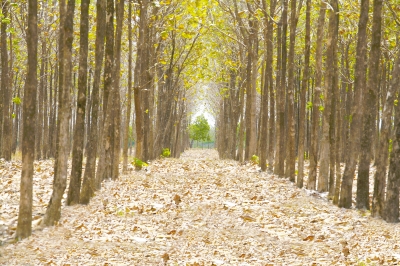
I like to think of it as finding my way by following a kind of trail of candy through the forest of my unwritten draft.
Image courtesy of David Castillo Dominici at FreeDigitalPhotos.net
I’ve been concentrating a lot lately on Novel Project #4, which is set in London in the 1760s. There’s loads of reserach material to forge through, and I have to admit it is, at times, distracting.
Today I’ve been focusing on familiarising myself with 18th Century London – trying to work out what shops existed and where, what were the nice areas to live in and what were the not-so-nice, that sort of thing. Owing to this period holding an enduring fascination with readers and writers, there is a wealth of information available, which is fantastic.
You just have to make sure you’re reading it properly.
The “Lady Kilmurray” shown in the ratebooks of 1680–1 must have been an undertenant of Dearham’s. She was probably the daughter of Sir William Drury of Besthorpe, Norfolk, and the widow of Charles Needham, 4th Viscount Kilmorey, who had died in prison in 1660 for the second time.
On re-reading it, I worked out I’d missed a line, which rendered the paragraph somewhat more conventional:
The “Lady Kilmurray” shown in the ratebooks of 1680–1 must have been an undertenant of Dearham’s. She was probably the daughter of Sir William Drury of Beesthorpe, Norfolk, and the widow of Charles Needham, 4th Viscount Kilmorey, who had died in prison in 1660. Her second husband, Sir John Shaw, baronet, died in March, 1679–80, so that she was a widow for the second time.
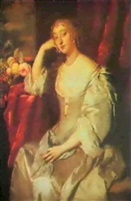
Bridget, Viscountess Kilmorey, whose first husband had sounded so very interesting.
If you haven’t checked out the excellent Paying For Our Passion series of guest author blogs David McDonald is doing over at Ebon Shores, I highly recommend it. Mostly because of the insight it provides into how different writers make this writing thing work, but also because (full disclosure) my guest blog went up yesterday.
Here’s what David has to say about his inspiration for the series:
Juggling your creative time with a full time job can be draining at the best of times, how much more so when you feel like the time put into writing is being wasted because it isn’t immediately a huge success? And, what about people who have to juggle being a parent or a full time carer as well? People with a chronic illness? How do they cope?
Because this is a personal issue, we often keep it to ourselves. Worse, sometimes we don’t talk about it because we think everyone else is living the rockstar writer lifestyle and we are the only ones struggling to find that balance–and we don’t want to look like a failure. I thought this was a subject worth exploring, and hopefully seeing how others deal with these challenges might a) help new writers realise they aren’t alone b) give us all ideas that might help.
So far, David has had guest posts from a range of Australian authors and editors, and has even started profiling some New Zealand authors after a recent trip there. I highly recommend the post from writer and poet Maureen Flynn as one that’s particularly moving.
So, what I have I sacrificed in the pursuit of literary glory? Well, the hint is in the title of this post. It’s fair to say my creative career can be characterised as a constant battle to balance the conflicting needs for sleep and writing time. Go read the article, and check out some of the others!
Such tragic news – updates on what I did last weekend will have to wait. News stories state she died in her sleep on Sunday after a long illness. She was 67.
I think Tanith Lee may have been the first “adult” author I read. I remember surreptitiously picking up a copy of Red As Blood, Or Tales From The Sisters Grimmer that was lying next to the spare bed in my mother’s house, and sneakily (because I wasn’t sure if I was allowed) reading all those dark, fantastical, twisted fairy tales, one by one. I vividly remember reading the first story, Paid Piper, and being both puzzled and fascinated by the familiar-but-different tale. In fact, I can remember my initial reaction to almost each and every tale from that small volume.
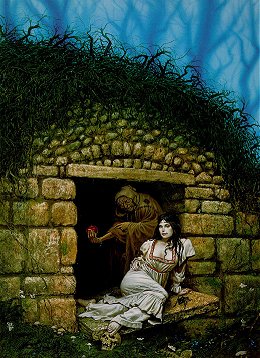
Michael Whelan’s cover art for the Daw edition of Red As Blood
(And how about that cover art by Michael Whelan? He managed to make Snow White look both sultry and horrific. Eleven-or-twelve year old me was terrified by that sensual image – but I kept going back and sneak-reading the next story.)
I’ve written previously about books that have helped formed the landscape of my imagination in some of my previous “reading for writing” posts. Well, this book is the bedrock.
It’s by no means the only one of hers I’ve loved. If you want some recommendations, Silver Metal Lover is rightfully iconic, and her Tales From The Flat Earth series showcases just exactly what wonderfully Byzantine, mythic story-telling she was capable of. The other stand-out, for me, is Drinking Sapphire Wine/Don’t Bite the Sun, which, like Silver Metal Lover is sci-fi rather than fantasy – but fantastical, strange and darkly beautiful science fiction. And, of course, her short stories, which I first tasted in Red As Blood. They are legion in number, scattered from here to the ends of the Earth; all filled with the arcane and evocative imagery she was famous for and threaded through with a rich vein of eroticism.
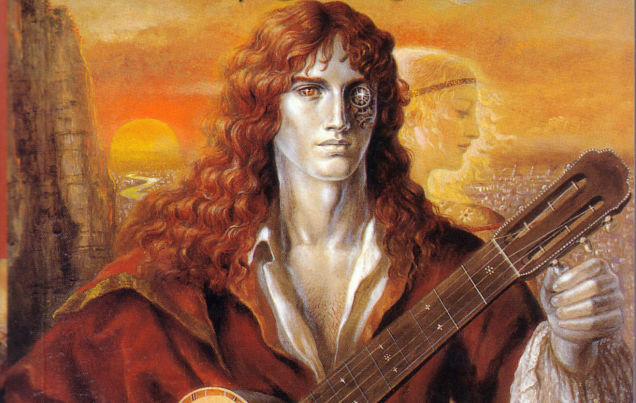
Silver Metal Lover, cover of the 2001 Voyager edition by Kinuko Y Craft
The news articles I have read about her death say she struggled to get her work published in recent years, which is a crying shame. This woman was an artist, and her incredible work has played no small part in shaping my own muse. When I write, if I get the slightest twinge of what I feel when I read her, I know I’m on the right track. I can only hope that following her passing, some of her unseen stories will be published in tribute to the body of work she produced during her lifetime.
Vale, Tanith Lee. And thank you, thank you, thank you.
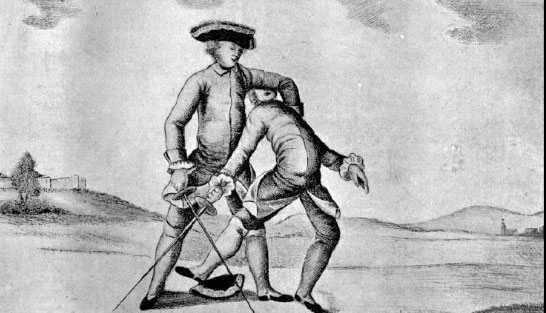
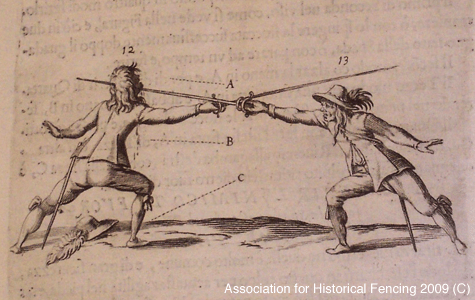
Tonight I’m doing some research on fencing schools in London in the 18th century. So have some awesome pictures of 18th century fencing.
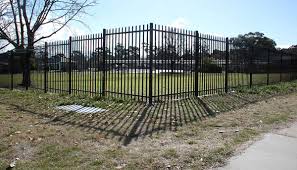
Being a very visual person, I do a lot of searching for useful images. So I was very puzzled when my last lot of Google image searching on fencing schools produced an abundance of images like this:
Sigh. We live and learn to refine our search terms.
This is one of those words that conjures up a whole array of other, equally awesome words: rogue, knave, scoundrel, varlet, slumgullion.
This word seems to have first appeared in the late 17th century, and is closely associated with the word rascallion, which was an earlier elaboration of rascal. Dictionary.com gives it a specifically feminine parallel in the word rampallion, which is yet another awesome word and came from the Middle English word ramp, meaning a rude or boisterous girl or woman.
Now, I love a good, rude, boisterous woman, so I found this quite fascinating in itself. In Middle English the word ramp also referred to an animal climbing or standing on its hind legs (such as in rampant, used in heraldry to indicate a beast depicted rearing up). Ramp, as a perjorative term for a woman then later became romp in the 18th century, defined in Johnson’sDictionary in 1755 as“arude,awkward,boisterous,untaughtgirl.”









 Leife Shallcross