Reading for Writing Part 1

I’ve had quite a literary week. On Monday I went to see the entertaining and debonair Joe Abercrombie talking about his new book, Half the World, at Harry Hartog’s (and what a beautiful Canberra bookshop that is.) I had the opportunity to chat to him before and after his talk; beforehand I quizzed him about the sex scenes he writes (!!!) and after the crowds had drifted off my CSFG buddies and I had a chance to chat to him about a bunch of things including the fantastic covers on his books.

Meeting Joe Abercrombie at Harry Hartog's
Meeting Joe Abercrombie at Harry Hartog’s (That’s me on the right, behind Shauna O’Meara. The rest of the CSFG crew, behind Joe, from left to right: Craig Cormick, Ross Hamilton, Tim Napper)

Then on Wednesday, we had our first general meeting of the CSFG for 2015, which my good friend Kimberly Gaal and I kicked off with a session on goal setting for writers.

How are these two things linked? Well, one question Joe was asked on Monday night was what is he reading now? His initial answer to this was interesting: he said “I don’t read anymore.”

I found this interesting because a quick Google search will throw back at you plenty of quotes from high profile writers telling aspiring authors that the one thing they must  do is read. But even so, this is not the first time I’ve heard a high-profile author say they just don’t read anymore.

Joe then went on to demonstrate that, actually, he does read (of course). But when he talked about reading, it was very clear that it’s not something he does for leisure these days. He reads a lot of non-fiction for research, and he indicated the fiction he reads now is mostly in genres other than what he writes (dark fantasy).

At our CSFG meeting on Monday, one of the things we talked about in relation to goal-setting, was doing a reading challenge as a useful way to expand our horizons, connect with readers, understand markets and feed the muse. (Here’s a great post from Elizabeth Fitzgerald over at Earl Grey Editing about reading challenges.)

This all got me thinking about what and why I read. I absolutely do not read anywhere near as much as I used to. I have no hesitation in saying it is one of life’s great pleasures. I was an inveterate bookworm as a child. I read Charlotte’s Web when I was six. I started reading the likes of Anne McCaffrey and Tanith Lee when I was about thirteen. I read and read and then I reread and reread again. In University, I wrangled my degree so that it was about 85% English Literature subjects. This meant I (was supposed to) read something in the order of thirty to forty books a year. I can’t say hand-on-heart that I did read that many, but I read most.

But now…

I find reading uses a similar part of my brain as writing. It also scratches a similar itch and fills in the same few spare hours. So for me, it’s often a choice. Read or write. Still, I definitely do read. I just have to be very selective. I’m also pretty brutal now about finishing books. If it’s not doing what I want it to do for me, I stop reading it. I do not have time to persevere with duds. I set aside one massively popular bestseller just recently because I could not stand either of the two main characters and I did not want to spend another minute in their company. If I decide I want to know how it ends (I’m not fussed right now, I don’t want either of them to prevail), I’ll go see the movie.

Having said all that, I do still read, and it is still one of my favourite ways to spend an hour. Or three. Or eight. Like most people who love books, I have a to-read pile that in its darker, more unstable moments could kill small children if it toppled over. So in my next blog post, I’ll talk about what and why I read, and how I prioritise that growing stack beside my bed. And the one on the bookcase. And the one beside the bookcase on the floor. And –

*sound of books falling*

*muffled screams for help*
Using POV to untangle plot

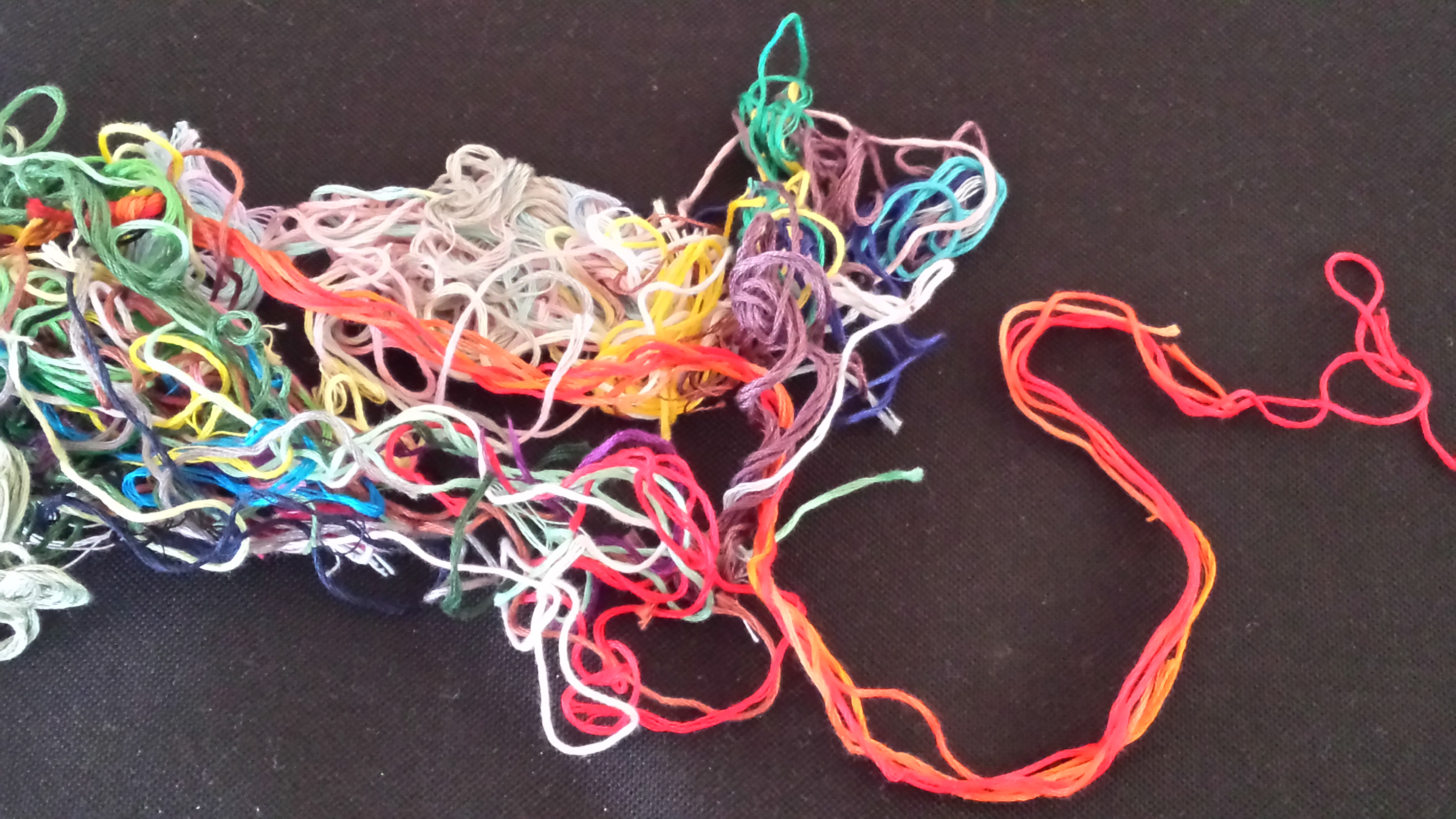
Tangled threads 2


A little while ago I decided I needed a clearer perspective on the villain’s story in Novel Project #3. So I sat down and plotted the story-so-far from his perspective. This proved to be an interesting exercise.

Humiliatingly, I discovered the plot actually didn’t work from his perspective. I had him on one side of the country on one day, then popping up on the other side of the country a few days later with no plausible reason for how he got there, or, worse, why he might have wanted to travel in the first place.

Learning No. 1: plotting your story from alternative viewpoints (even if the story is never told from these viewpoints), is a valuable tool for uncovering plot holes.

Then, I got stuck. I got to a point in the story where I couldn’t work out what should happen next. I knew where I wanted my heroine to end up, but there was a hefty gap between where she was and where she needed to be, and I couldn’t think of anything interesting to fill it. I had that sense of having to write some stuff to fill time before the next chunk of story started, and we all know what a mortal blow that is to plot.

I’d had a sense for a little while that my backstory needed more work, and that some of the plot points so far weren’t quite as convincing as they should be. And what do you know. When I went back and did the work on the backstory that it needed, my story came to life again. By understanding more about what was going on with my villain and a couple of the supporting characters, I understood what else was going on in my story that would galvanise the next chapter of action and excitement. I couldn’t see it before, because I was only looking at it from my heroine’s perspective, and she has no idea about this other stuff that’s going on.

Learning No. 2: Not everything important that is happening in your story is going to directly involve your protagonist, even if it does end up affecting her. Plotting your story from alternative viewpoints will enable you to understand the other currents flowing through your plot, and to know when and how their effects will manifest for your protagonist.

Coming up: reading & panel discussion at Conflux 10

Spectacular artwork for Conflux 10 by Shauna O'Meara
Spectacular artwork for Conflux 10 by Shauna O’Meara

Conflux is on this weekend!! This is the annual Canberra spec fic convention, and lucky for me it has a very strong focus on writing.

I’m participating in a couple of events:

  • On Saturday, 4 October at 12.0o, Simon Petrie will be launching his new collection of short fiction, Difficult Second Album, by Peggy Bright Books. At the launch, some of the other recent titles from PBB will be showcased, including Use Only As Directed. So I shall be doing a reading from “The Blue Djinn’s Wish”!
  • On Monday, 6 October at 4pm, I will be part of the Denouement – the Journey’s End panel with Richard Harland and Daniel O’Malley!

I’ll also be doing my bit to staff the CSFG table in the dealer’s room around lunchtime on Saturday & Sunday, so please come along & say hi!

Making up words

Want made up words? Lewis Carroll got made up words!

In 2011, when I decided to ‘get serious’ about my writing, one of the first things I did was book myself into a Year of the Novel course with the very knowledgeable and generous Craig Cormick, through the ACT Writers Centre. One of the very first exercises he got us to do, was describe our favourite kitchen appliance in one sentence, without mentioning what it is. I came up with:

When it’s packed, the mess is gone, and I can go and write.

(Can you guess?) Then, of course, we had to condense it down to one word. One word? The man is crazy, I thought. Then he uttered the magic phrase… “If there isn’t a word, you can make one up.” (Or something like that.) Awesome. It came to me almost straight away.

Squared-awayness.

Now, I could have gone with ‘neat’ or ‘clean’ or something like that . But none of those words conveyed the sense of satisfaction I have at achieving a kitchen that doesn’t have dirty plates and used saucepans scattered over every surface. For some reason, if my kitchen is messy, I feel like my mind is cluttered. Words like ‘tidy’ give you a sense of the end product, but they don’t describe the journey. My word conveys (to me, anyway) a sense of my active participation in achieving that state. And there’s the rub.

If you’re going to go making up words, you run the risk of creating something that’s meaningless to other people.

Words like ‘squared-awayness’ probably don’t carry that kind of risk, because I’ve picked something that already carries meaning and just levered it into a grammatical convention that makes it one word instead of two. But, especially if you write speculative fiction like me, which often involves making up worlds and cultures, you might want to make up new words, just coz they sound cool, or there isn’t quite the right word to convey what you want. In this case, you’re going to have to rely heavily on context to get across your meaning, or you can leverage off existing words that sound similar. ‘Frack’ as a pseudo-swear word is a good example of this, although thanks to the Australian coal-seam gas mining industry, that word now has a boring and slightly depressing, well-understood technical meaning.

So there’s your second risk. You might end up with a word that means something different to other people, to what it means to you. Here’s a couple of examples from one of my works in progress. This has a late-medieval-ish setting and a lot of the characters are peasants, or common household or forest-dwelling fairies loosely based on various bits of British folklore. I’ve tried to create a kind of vernacular for the story to give it a certain feel. But, here are two of the inadvertent missteps I’ve made along the way.

Lumpen

What I meant: a variant of lumpy, but with a more colloquial sound to it.

What it actually means:  (according to Dictionary.com) of or pertaining to disenfranchised and uprooted individuals or groups, especially those that have lost status. It can also mean stupid or unthinking (how’s that for irony?) and comes from the German word for vagabond.

Welkin

What I meant: something daft or stupid. I totally made this up. I just liked the sound. I think I derived it from whelk, which is a hilarious-sounding shellfish. (I don’t think you get whelks in forests, though.)

What it actually means: the sky. From the Old English welcn and related to the German word Wolke, which means cloud. Who knew?

Well, one of my sharp-eyed, German-speaking beta readers, that’s who.

Obviously, I should have done a bit more due-diligence. I remember reading about J K Rowling Googling the term ‘Horcrux’ when writing the 6th Harry Potter book.  (Now there’s a woman who’s great with made-up words.) She says she was so relieved to find no Google matches on it at the time, because she really liked the word and desperately wanted to use it. (Try Googling it now!)

So the moral of this story is: be creative! Make words up. But you might want to double check to make sure you’re using something that, well, means what you think it means.

The motivations of ghosts

Recently, I wrote a ghost story. I sent it off to some writerly friends for feedback, every single one of whom came back to me saying, ‘Well, from this point on it was clear it was going to end in ghostly revenge.’ Which, obviously, was a bit of a problem I had to address in the rewrite (hopefully I have). However, it also led me to thinking on the motivations of ghosts. My initial reaction to the feedback (apart from Argh, how do I fix this?) was, well, what else do ghosts want?

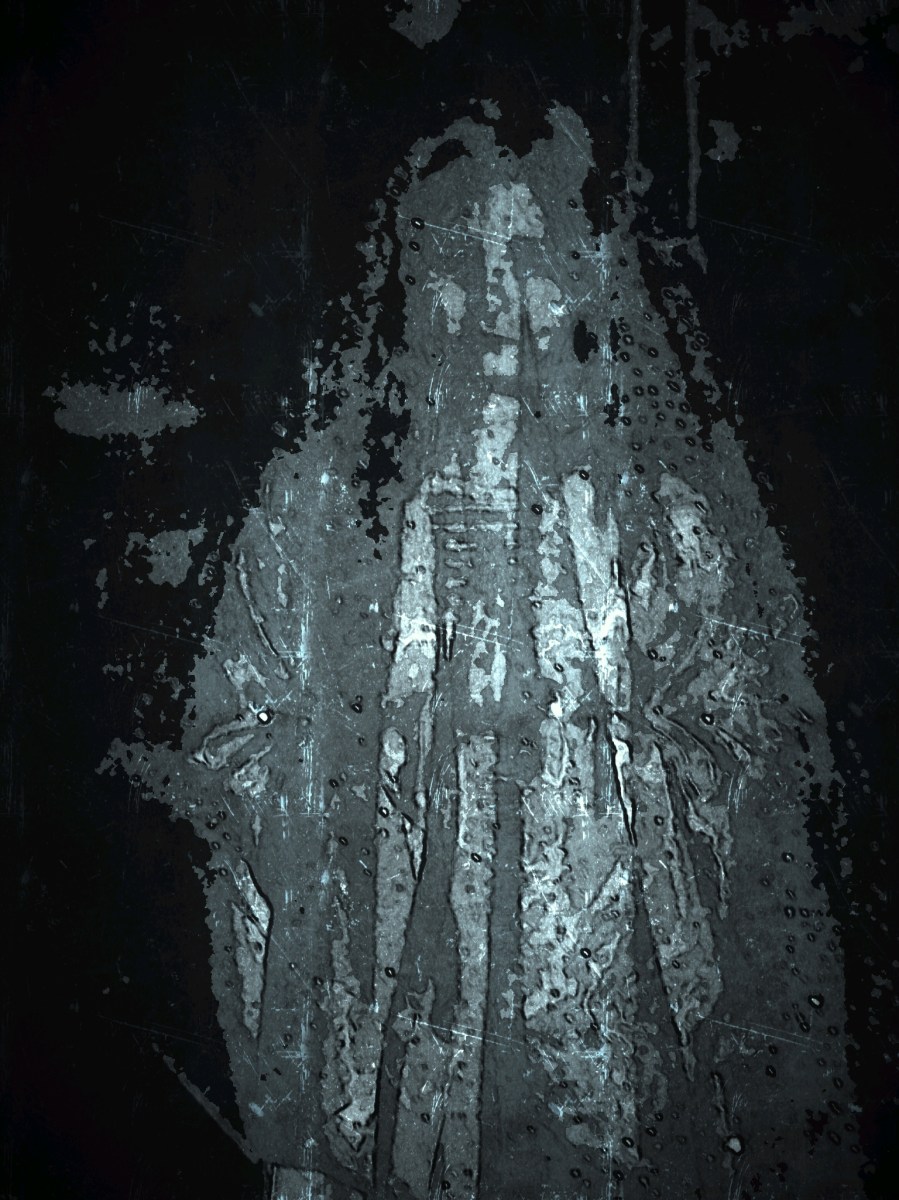
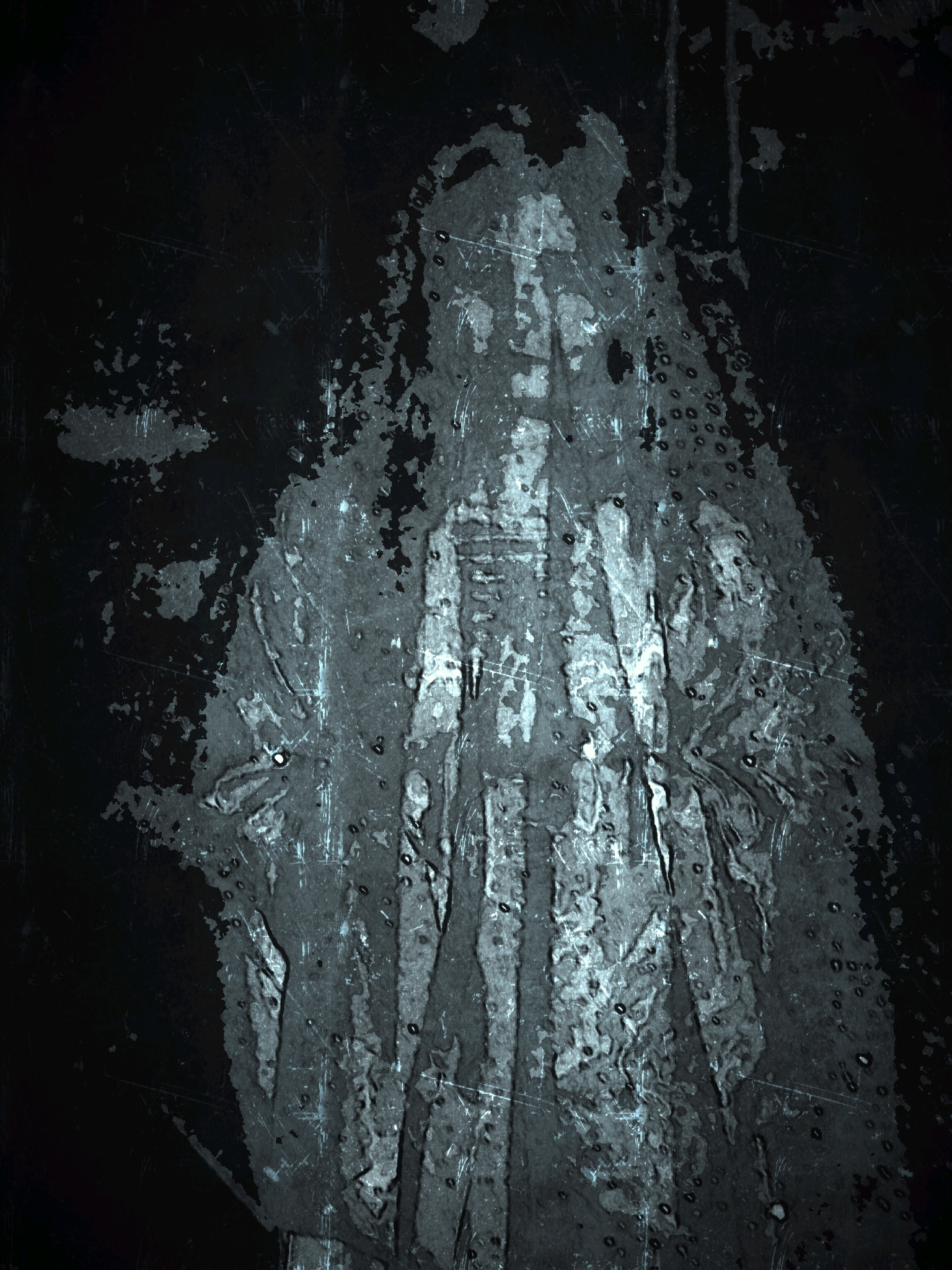
Ghostie 8

After thinking about it for a while, I decided it could be any number of things, actually. Thinking over the ghost stories I remember, it seemed to come down to the reason why the ghost was…well, a ghost. So, in the interests of adding a bit of diversity to my characters next time I attempt a ghost story, here are the things that I came up with that might reasonably motivate a ghost.

1. Revenge

Due to something to do with the manner of the person’s death, their ghost is now seeking revenge. Outright murder is an obvious one, but perhaps their persecutor made them miserable and drove them to suicide, or framed them for a crime that carried a sentence of death, or was somehow negligent, with fatal results.

One of my favourite ghostly revenge stories is that of Pearlin Jeanne, who haunted her faithless lover’s stately home at Allanbank in Scotland. She was killed in Paris when she tried to prevent her Scottish lover leaving her by climbing onto the wheel of the coach he was absconding in. He ordered the coachman to ‘Drive on!’ She fell and her head was crushed under the wheel. Her dying threat was that she would always come between her lover and any woman he married. From that day, Allanbank was troubled by the apparition of a young woman in a bloodied pearlin lace veil…until someone came up with the ingenious solution of hanging a picture of her between the portraits of the baronet and his wife.

2. Justice

This is possibly another version of ‘Revenge’. I suspect that the vengeful ghosts are likely to be the ones that wouldn’t normally have recourse to any other avenue of justice. So the justice-seeking ghosts must have a level of confidence in some sort of earthly authority to deliver retribution for them.

3. Closure

The timing or manner of the ghost’s death left something important undone. Something the ghost is determined to complete. There are some great stories about ghosts who knew something, but never communicated it to the person who needed to know it in life, so come back just for this purpose. Often it’s the location of the family fortune or some other treasure. But, then there are tales like Joan Aiken’s ‘The Ghostly Governess’ from All but a few (one of my all-time favourite childhood reads), in which a rather sweet, if slightly autocratic, governess is unable to rest until she is satisfied that she has taught her students the things they are supposed to know.

4. Warning

The ghost is compelled to return either to warn someone about something similar to what happened to them, or to save a loved one or descendant in peril. Like the young woman whose death somehow resulted from her giving in to the amorous advances of a local rake. Her ghost then developed the disconcerting habit of appearing before other maidens who were on the point of making the same mistake. I really hope, for equity’s sake, that she made some effort to haunt the guy who caused her death, but I don’t remember that being part of the story.

5. To fulfill a promise

This is an interesting one. It could be the ghost’s determination to make good on their word that has kept them around. But, it could also conceivably be the power of the promise itself that has called them back.

6. Can’t let go

There’s probably a few reasons here that fit under the category of ‘can’t let go’, but sometimes there’s no other reason, other than life is good, death is unknown, so why not hang onto what semblance of life you can, while you can? Or maybe they’re just so enraged at the thought of having died, they’d rather share the misery by hanging around and venting their anger on the living. Or, maybe, there is something, some person or object, that their affections and energies were so bound up in, that they just can’t bear to leave it and move on. Like this fantastic story from Yorkshire in the UK about a young woman who died just  as her family’s grand, new, stately home was nearing completion. Distraught that she would never see it finished, she made her grieving family promise to cut off her head and keep it in the house so that she might watch over it. When they buried her (whole) in the churchyard, the house was beset by all manner of ghostly annoyances until they relented and finally brought her head inside (ew!)

Then, of course, there are the ones that don’t seem to realise that they are ghosts, so they don’t know that they have to let go.

7.  They’ve been called

There are plenty of stories of people who have passed on perfectly peacefully, yet are disturbed in their rest by thoughtless individuals who seek to reawaken them for their own purposes. If you’re going to go around raising happily slumbering spirits, the consequences are on your own head.

8. They’ve lost their way

I suppose this is centred on the idea that there is some sort of journey for the ‘soul’ to make after death to whatever place it is that souls go, and some of those souls get distracted or lost en route.

9. They know where they’re headed, and they don’t want to go

There are also stories of ghosts who know exactly what’s in store for them after death, so they do what they can to avoid that well-deserved fate. Like the blackguard lord who died unrepentant, and whose unquiet spirit then went and stuck his head through the stained glass window of the local church in order to thwart the devil’s attempts to collect his blackened soul, on the basis that once he was on hallowed ground, the old goat couldn’t touch him.

10. Psychic shock

Perhaps the manner of the person’s death was so sudden, or shocking, or violent, or tragic, that it caused some kind of psychic shock. These are the kinds of ghosts who don’t seem to have any attention to spare for the world of the living; they’re simply too caught up in endlessly reliving their own last moments.

I once read an account of a place in Britain that was supposedly haunted by a legion of ghostly Roman soldiers, who would march through a basement over the ancient remains of a Roman road. I always wondered why it would be the whole lot of them at once. Maybe they were off to some battle that went badly for them, and this was some sad remnant of their final march.

So there you go. There’s a bunch of motivations for ghostly characters that I’ve come up with. What do you reckon? What have I missed?