Operation First Draft: Week 2

This week has been a bit of an exercise in frustration, and a reminder that writing is not all about just getting words on the page. Sometimes it’s about sitting there, staring into space, maybe for hours, with the same song on repeat. Or going for a long drive, or a run, or sitting on the bus with that song on repeat. Or delving back into your research to try and pad out some ideas, or generate new ones. All the while, with that one song on repeat.

It doesn’t feel very productive, but this is also the kind of thing I rarely get time to do in the normal course of things.

So, in the interests of at least presenting an appearance of productivity, here are a few snippets of visual inspiration I found while trawling through Pinterest.

Operation First Draft

I’ve taken some time off the day job! Eight whole weeks. Woo! But I’m not having a holiday. Just doing a different kind of work. I want to complete a first draft of one of my WIPs. So this week I’ve been head down, busily writing away.

Monday

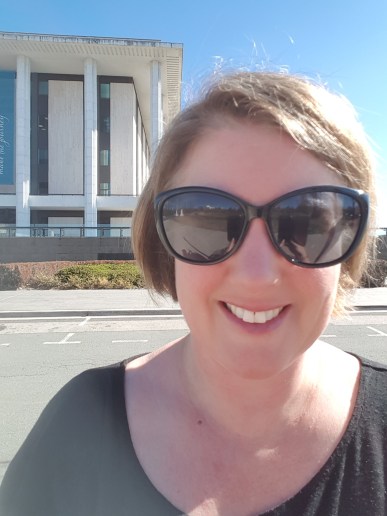
Reporting for duty at the National Library of Australia.

20170814_110037

I figured if I treat it like a job and leave the house every day, hole up somewhere quiet (preferably with coffee) and just focus, I’ll be less likely to arrive at the end of  the 8 weeks and find I’ve accidentally constructed my dream vegetable garden or cleaned out the garage instead of finished the novel.

Tuesday

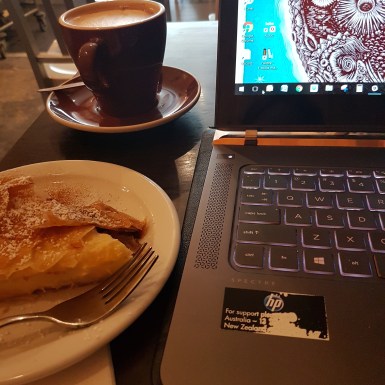
Holed up at Good Brother Cafe with a slice of semolina custard pie.

IMG_20170815_125610_308

Wednesday

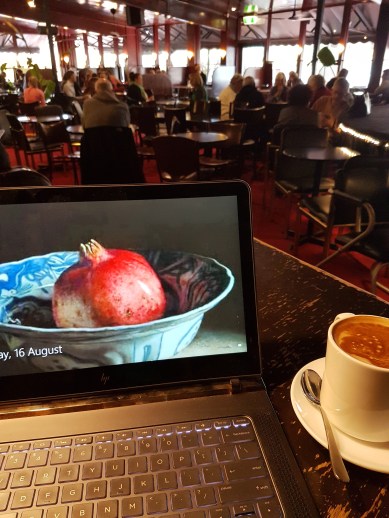
At the iconic Tilley’s Devine Cafe.

20170816_105554

Thursday

Back at the National Library writing in the cafe under the light of their glorious stained glass windows.

Friday

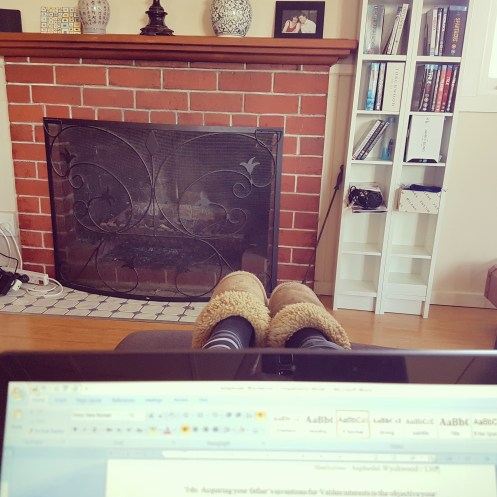
Um. Friday was a bit of a yukky day. So I broke out the fluffy slippers and parked myself on the couch. It was still moderately productive and far too wet and windy to make landscaping an attractive alternative to plot-wrangling.

IMG_20170818_132110_525

Progress?

I’ve added around 4000 words to the MS, put the plot in order and stitched up a couple of ugly holes. That’s probably OK for a MS I haven’t looked at for months. My aim is to get myself up to doing at least 2000 words a day. The MS is currently sitting on 41K, and I’m aiming for about 90K.

And what am I writing?

Aha. Spoilers. It’s another standalone and it’s fairy tale related. Maybe I’ll leave some hints lying around here over the next few weeks.

Dreaming up a city

So this weekend’s writing job, while I do a bunch of other, non-writingy jobs, is to start dreaming up a city for one of my current projects.

I’m a big advocate of the setting-as-a-character-in-its-own-right school of world building. My favourite novels are the ones you want to keep re-reading because you just enjoy being in the world of the story so much. Think JK Rowling’s Hogwarts, Anne McCaffrey’s Pern, Terry Pratchett’s Ankh Morpork, Enid Blyton’s Enchanted Wood, Diana Wynne Jones’ Moving Castle. And just to show this works outside fantastical stories, Frances Hodgson Burnett’s Secret Garden and Georgette Heyer’s Regency London. In fact, one of my big motivations behind writing The Beast’s Heart was to write myself a fairy tale world I could go and live in for a little while.

I have some sketchy ideas for this city, but so far it’s really just been a backdrop for the action in this new story. I want to level it up a bit, deepen it’s character, really bring it alive. I want my city to have twisty, shadowy alleyways lined with crooked buildings, cobbled streets and piazzas, a complicated clock tower, avenues of terraced mansions, moonlit shenanigans on rooftops, a river with treacherously damp water stairs, a monumental bridge lined with statuary, and a royal palace with towers and turrets. I want it to have all this and hold out the tantalising promise of more.

I have a whole Pinterest board of city inspiration.

I love looking at old photographs of cities in times gone past for inspiration.

I also love using old paintings and drawings for city inspiration. I find it interesting to look at what drew the artist’s eye. What was it about the city they thought was worth capturing? Rooftops? Stately buildings and squares? Shadowy spaces and archways leading…where?

And I’ve been mainlining illustrations by the likes of Anton Pieck and Arthur Rackham, who did delightful, fairy-taleish cityscapes.

What are your favourite literary cities? And what brings them alive in your mind?

Spectacular things

Two – count them! – spectacular things happened to me today. First a package arrived on my doorstep this morning. What could it possibly have contained? Oh, just the PROOF COPIES OF MY FIRST EVER PUBLISHED NOVEL.

Sorry, sorry. Got a bit excited. I’ve turned the caps lock off now.

Then I fired up the internet to see Hodder & Stoughton released the blurb today!

My Twitter went nuts for a bit.

I am not complaining. It’s actually kind of humbling to know people are excited to read something I wrote. I’m ecstatic, as well. But when I opened that proof copy today and saw my words – my very own words – all lined up on the page of an actual book, well, I had a moment. I got a bit trembly.

I just hope that I can go some way to fulfilling the hopes of those people who are excited for this story, and they will love it at least a little bit as much as I do. *crosses fingers* *closes eyes tight* *wishes hard*

Ending the drought

For obvious reasons, I have been on a self-imposed ban on consuming any Beauty and the Beast stories for the last – oh, I don’t know – five years. But the manuscript is finished. The edits are done. Last week I even watched the Disney live-action B&B movie for the first time. And now I am ready to wallow in other people’s Beauty and the Beast imaginings. So.

What Beauty and the Beast retellings should I indulge in? What are  your faves?

To get you started, I’ve got these two lined up ready to go. An old, old favourite and a brand new treat (all freshly signed from Kate’s fascinating talk at the National Library in Canberra last week!)

2017-07-30 11.28.37

Gimme your recs! Go!

Those proofs

My big news this week is that the printed proof copies of The Beast’s Heart have arrived in the London office of my publisher, Hodder & Stoughton, and a small pile of them will soon be winging their way into my waiting hands.

To say I’m excited is putting it mildly. Up until those photos were tweeted, I had only seen the front cover, so I’m still swooning a bit over the detail on the spine and I had to pinch myself to make sure I wasn’t dreaming when I read the lovely words they’ve put on the back.

If you would like to receive a review copy, Hodder has information available for book bloggers here.

If you’re an Australian reveiwer, your best bet is probably going to be through Hachette Australia on Netgalley.

An oval mirror in an ornate frame on a deep blue background. The mirror has been shattered.

Proof

So this little piece of exquisiteness just got revealed on Twitter over @Chapter5Books tonight.

It’s waaaaay past midnight here, and I’m so excited I can barely breathe, let alone sleep. And this is just the proof cover! The hardback cover reveal is still to come!

Between this and the Tour de France I’m not going to get any sleep tonight, am I?

Touchstones: Chris Breach

I’ve been thinking a lot about story touchstones this year, starting with my post from a few months ago on Sapsorrow’s Dress. As well as exploring some more of my own imaginative touchstones, I decided to ask a bunch of other writers about theirs. This week I’ve invited one of my 2016 HARDCOPY buddies, Chris Breach, to share his thoughts on something that inspires him and captures something of what he aspires to in his own writing.

Hey Chris, thanks for coming! OK… What is your touchstone?

Maurice Sendak’s Where the Wild Things Are.

I love that book. When did this book first emerge as a source of inspiration for you? Where did it come from?

Well, it’s a classic, one of those books you read without thinking about how good it is, necessarily. It was not until I started reading it to my kids (multiple times, night after night) that its genius began to reveal itself. For example, have you ever realised that each picture is a different shape or size? The first image is the size of a postcard, roughly, then each picture increases until you reach the three full pages where there is no text at all—just Max and the wild things roaring and dancing to the moon, swinging in the trees and parading around. Then the pictures start to shrink again as he returns across the ocean and back to his room. These sorts of intricacies reveal themselves with multiple readings, which is something I love in anything I read.

Why do you think it resonated with you so strongly?

I think we share a similar outlook on life, for whatever reason. I did not lose the majority of my family in the Holocaust, I was not traumatised by the Lindbergh baby kidnapping and murder in 1932 (as Sendak has said he was)—but I also believe that life is not fair, that it is, for the most part, a challenge, but one that has its moments of joy and tenderness and love in amongst the shit. We are both pessimists, I suppose, and attracted to the dark instead of the light. It has been worth remembering that he once vowed he wouldn’t write stories of sunshine and rainbows, because that’s not real life.

How has Where the Wild Things Are inspired your writing? Have you ever written directly about it, or does it lurk in the background of your stories?

Sendak has a control, a tightness, in his writing that is inspiring to me. I love reading short, tightly controlled narratives, and I aspire to that same succinctness in my own writing: to be able to say the most with the least number of words. I could have easily picked Oscar Wilde’s The Picture of Dorian Grey or Cormac McCarthy’s The Road for great examples of taut storytelling, but there are—surprisingly—a large number of similarities between my latest manuscript (a verse novel about racism and mass murder) and Where the Wild Things Are—they both feature morally ambiguous characters, a story without a clear resolution, and benefit from repeat readings. They have an unsettling element of fear that permeates the narrative but is never explicitly stated. And most of all, Sendak has a fearless approach to his writing that is inspirational, refusing to follow established patterns in the publishing industry (which, incidentally, got his books banned more than once).

I’ll leave you with, perhaps, my favourite quote from any author, living or dead:

I know my work is good. Not everybody likes it, that’s fine. I don’t do it for everybody. Or anybody. I do it because I can’t not do it.

Something for all us writers to aspire to.
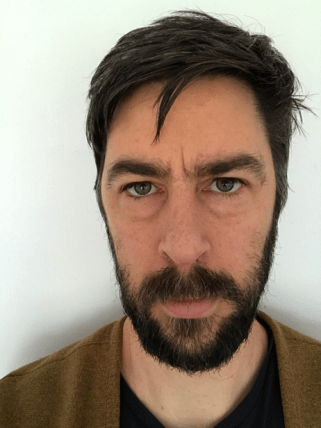
Chris BreachChristopher Breach was the overall winner of the Lord Mayor’s Creative Writing Awards in 2011. He was selected as a participant of HARDCOPY in 2016, a manuscript development and industry information masterclass. He participated in The Lost Art of Letter Writing as part of the Shepparton Art Festival 2016. He was a finalist for the ACU Prize for Literature in 2014 and for the University of Canberra Vice-Chancellor’s International Poetry Prize in 2015.

Epilogue

Just as I was prettifying this post for publication, Chris alerted me to this beautifully timed piece of exciting news…


News! A Hand of Knaves

cropped-csfg-site-logo

The CSFG has announced it will be opening to submissions on 1 August for its newest anthology, A Hand of Knaves, to be published in late 2018 and edited by my good friend Chris Large… and yours truly!

I’m not sure this is the most sensible decision of my life – I’ve got plenty of stuff going on next year after all (*cough*The Beast’s Heart*cough*), but Chris asked so nicely and I think the concept (which is totally his), of an anthology of stories about scoundrels and ne’er-do-wells is just brilliant. My imagination has already exploded with ideas!

We’re going to be looking for stories of up to 5000 words featuring knavish characters who are anything from mischievous rogues right through to evil bastards. It’s got to be speculative; we want a good mix of sci fi, fantasy and horror and all the sub-genres in between. We welcome stories from and about the full and glorious spectrum of human beings. Our main criteria (apart from those listed above) is that it just has to be good. The catch is that, given CSFG anthologies are a showcase of Australian speculative writing, you do have to be Australian, or an Australian resident, or at least a member of CSFG to submit. Head over to the CSFG Publications page to find out more about the kinds of stories we’re going to be looking for and how to submit.

This is going to be awesome.