This is one of those words that conjures up a whole array of other, equally awesome words: rogue, knave, scoundrel, varlet, slumgullion.
This word seems to have first appeared in the late 17th century, and is closely associated with the word rascallion, which was an earlier elaboration of rascal. Dictionary.com gives it a specifically feminine parallel in the word rampallion, which is yet another awesome word and came from the Middle English word ramp, meaning a rude or boisterous girl or woman.
Now, I love a good, rude, boisterous woman, so I found this quite fascinating in itself. In Middle English the word ramp also referred to an animal climbing or standing on its hind legs (such as in rampant, used in heraldry to indicate a beast depicted rearing up). Ramp, as a perjorative term for a woman then later became romp in the 18th century, defined in Johnson’sDictionary in 1755 as“arude,awkward,boisterous,untaughtgirl.”
Last Saturday was a whirlwind of genre fiction goodness. First up I spent the afternoon at the launch of Ian McHugh’s award-nominated collection Angel Dust. His stories range from whimsical fantasy about turning fairies into wishes right through to one of the most fascinating and memorable sci-fi stories I’ve read, which interrogates how our assumptions might hamper our ability to understand and relate to an alien species. You should get it and read it. It’s awesome.
After that, I headed home for a nice cup of tea with the eternally energetic Nicole Murphy, which provided a much needed breather before the evening’s entertainment kicked off: the 2014 Aurealis Awards!
This year, as president of the CSFG, I was invited to present the awards for best collection and best anthology. I had the very great pleasure of being able to hand over the former to the formidable writing team that is Angela Slatter and Lisa L Hannet for their collection, The Female Factory; and the latter to Garth Nix, who was collecting on behalf of Alisa Krasnostein and Julia Rios, for their anthology Kaleidoscope: Diverse YA Science Fiction and Fantasy Stories.
Seeing as it was also the 20th anniversary of the awards, we were encouraged to get into the spirit by donning 90s clothing. My effort was limited to digging out from the back of my cupboard a pair of boots I bought in 1992 (covered in approximately 20 years of dust and cobwebs) and teaming these up with a felt fedora and a pair of big hoopy earrings. But some people went to quite a bit of effort…
It was a great night, and I really hope I can go next year when it will be in a location yet to be disclosed, but probably not Canberra. Check out the full list of nominees and winners over on the Aurealis Awards blog.
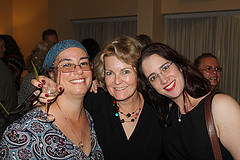
Garth Nix, Margo Lanagan, Ian McHughIan McHugh, Dennis Murphy, MeShauna O’Meara, who didn’t stuff up the powerpoint slideshow even onceTehani Wessely, Angela Slatter, Lisa Hannet, Liz GrzybThoraiya Dyer, Cat Sparks, Rivqa Berger
I have been sitting on this news for a long time, now, but I’m really thrilled to announce that my story Wandering Star, will be appearing in the third book of The Apocalypse Triptych, The End Has Come, edited by John Joseph Adams of Lightspeed Magazine, and Hugh Howey, author of the New York Times bestselling novels Wool, Shift, and Dust.
Quite aside from the editors, there are some stellar names in the table of contents of this anthology, and the previous two Apocalypse anthologies have come out to great reviews.
Author & social media guru Zena Shapter is doing a series of blog posts on what music inspires authors, and today she’s profiled me! Head on over to see what I, and dozens of other authors Zena has interviewed, like to listen to, to feed our muse.
I was only going to do two posts on reading. Then Elizabeth Fitzgerald asked me what makes me really want to read a book, and I conceived a third. Then I read this Huffington Post article: 20 New Classics Every Child Should Own, and a fourth popped into my head. I decided to do this one first, just because reading to my kids was first on my list of why I read books.
The Huff Post article made me sad my kids are past the age of picture books. (I consoled myself with the thought of the new list of wonderful gifts I now have to chose from for my littlest friends.) But it also made me think about why I choose the books I do to read to my kids. This list of 20 new classics was compiled by Jordan B Nielsen, a children’s book buyer for an independent book store, and reviewer of children’s fiction. She was driven to create this list as a response to her dismay over her experiences with adults who, buying books for children, eschew purchasing more recently written books for the books that they loved as a child.
Nielsen is sympathetic; she acknowledges that the choices of these adults for ‘time-worn favourites’ come from a desire to share with a child a much-loved reading experience from their own childhood. But, as she rightly points out, there are so many really wonderful new books for kids out there.
This made me think about why I choose the books I do to read to my kids. Without doubt, there is a selection in there of books I have read and loved, and that have played no small role in shaping the literary landscape in which my imagination plays. A selection of these includes:
All But A Few, Joan Aiken
The Harry Potter books, J K Rowling (technically I read these as an adult, but I started before I had kids.)
The Snow Spider, Jenny Nimmo
The Ramona books, Beverly Clearly
The Faraway Tree & Wishing Chair books, Enid Blyton
Howl’s Moving Castle (which might be the best book ever written) and its sequels, by Diana Wynne Jones; actually, make that pretty much anything by Wynne Jones
Pippi Longstocking, Astrid Lindgren
The Ordinary Princess, M M Kaye
Playing Beattie Bow, Ruth Park
Pretty much anything by Roald Dahl.
But I am totally with Nielsen in agreeing that this is only a small selection on the vast and wonderous selection of enchanted worlds on offer for children thesedays. Some stories that were not around when I was 12, but which we have dived into gleefully (I invite you to imagine the howls of protest when I close the book and insist they go clean their teeth after I have read myself hoarse over the course of three chapters in an evening):
The Skullduggary Pleasant books by Derek Landy (A skeleton detective? Awesome. Not to mention his equally awesome teenage sidekick, who is the protagonist and a great female character.)
The Spiderwick Chronicles by Holly Black. Oh how I wish these had been around when I was a kid.
The Series of Unfortunate Events by Lemony Snicket. I can’t tell you how much I love this man’s work. These books were written to be read to kids by adults.
The Beasts of Clawstone Castle, Eva Ibotson
The Thief Lord, Cornelia Funke
The Tashi stories by Anna Fienberg
Which brings me to the one guiding principle I have in selecting books to read my kids. I don’t so much want to share with them the experience of reading a specific book, as the experience of being completely transported by a wonderful story. The clues I look for? An intriguing title, a beguiling concept, fascinating characters, a world that makes me want to get dinner over and done with so we can pile onto my son’s bed and sink together into the pages.
Parenting win
My 12 year old daughter just finished reading the Infernal Devices series by Cassandra Clare – books I have not read (yet). She came out of her room yesterday, and curled up next to me on the couch with a sad little look on her face. She snuggled up against me and said forlornly “I’m going to miss them.”
She was talking about the characters in the story. And that makes me feel like I’ve done it. I’ve shared enough of my own reading experiences with her, and we’ve shared enough new ones together, that I’ve succeeded in instilling in her the love of reading and story that is so precious to me. Now she can go off and have her own experiences that will enable her to shape a unique landscape of imagination of her own. I have given her that gift.
Palimpsest: a page of writing, particularly on parchment, that has been erased or scraped clean to allow for new writing.
This is another one of those words that is a whole story unto itself. What did the original writing say? Why was it erased? What was so important about the new writing that the old had to make way?
Palimpsest comes from the Ancient Greek palimpsestos which means ‘scraped again’. Cicero, the Roman writer and orator, used it to refer to the Ancient Roman practice of writing on wax tablets, which were then smoothed out to be used again. So the term is rooted in a practice of utilitarian necessity.
Even so, I find the idea of lost or hidden knowledge that the term palimpsest implies completely beguiling.
In my last post, I talked about how being a writer has limited my capacity as a reader. But I don’t want to give the impression that I don’t read any more. Far from it. I just find I have to be a lot more selective these days.
A small portion of the teetering to-read pile.
So what do I read and how do I prioritise? Well, here are some thoughts. In terms of priority, it’s roughly in order, but subject to change on the basis of necessity or whim.
1. I still read to my kids. I’ve put this first, because it happens almost every day, so it probably makes up the bulk of my fiction reading, even though it’s not technically for me. They’re 12 & 10 now, but they love being read to. Right now we’re reading Joan Aiken’s All But a Few. But we’ve worked our way through plenty of fabulous books. This is pure, unadulterated fun.
2. Books I really, really want to read. These are the ones that furnish the landscape of my imagination. These books have built the pantheon that I want to be a part of as a writer. They feed my muse and inspire me.
3. Books I want to read because they’re going to help me improve my craft. They might be beautifully written, or have an intriguing story premise, or won an award, or have caught the zeitgeist, or be somehow relevant to my own work.
4. Beta reading for friends. It might not be for leisure, but it’s reading fiction written by someone else and it certainly helps my own craft.
5. Non-fiction reading, usually for research, but sometimes for fun. Hell, the best research is fun.
6. Catching up on published work by friends. This is basically an impossible task now. But I do what I can.
And that’s it. That’s all I can fit in.
What I find interesting, now I’ve put that list together, is how all of it ties back, somehow, to supporting my own writing. It might just (just! *rolls eyes*) be reigniting my passion for stories and beautiful words, or it might be something more concrete, like learning more about a historical period, or how to construct a murder mystery. But I can’t not read without that writer part of my brain ticking over, hoarding the good stuff and putting squiggly red lines under the bad.
Which tells me, ultimately, that time spent reading is time well spent. Even though – or perhaps because – it’s rarer and more precious than it used to be.




 Leife Shallcross